
FAQ’s & Resources
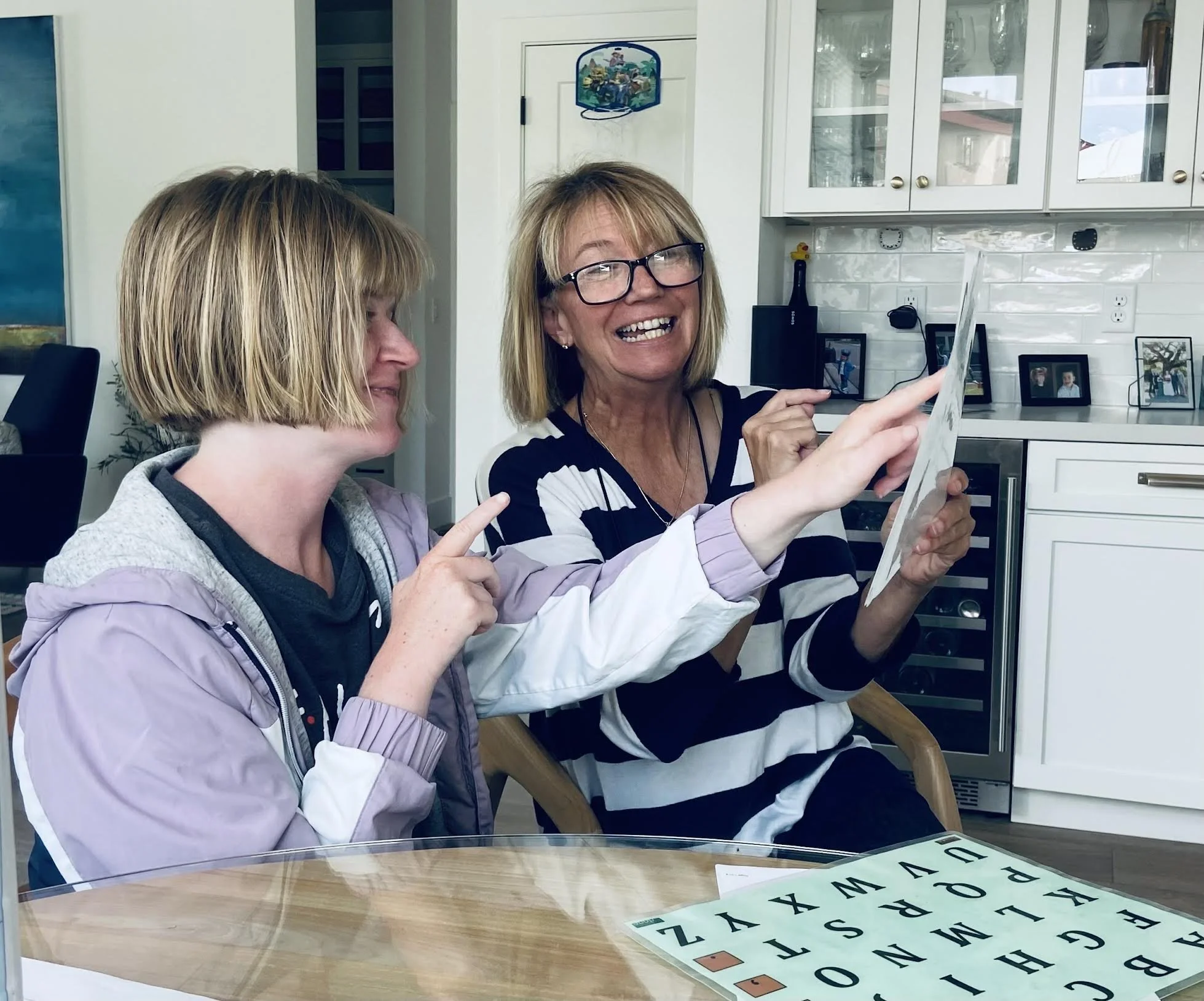
Jeannie (mom) & Erin, age 26
Frequently Asked Questions
Q: What is spelling?
A: Spelling is a motor-based path to communication: a person points to letters (on a letterboard, keyboard, or device) to spell words, showing what they know and think—even if speech is limited or unreliable. In other words, we’re building purposeful motor planning so cognition can show up on a letterboard. (All people develop language; not all develop reliable speech.)
Q: How does spelling work?
A: Spelling approaches teach purposeful, goal-directed motor skills—eyes look to the target, the arm/hand initiates, and the finger lands on the intended letter—repeated until the skill becomes smooth and automatic. Over time, many learners move from larger boards to keyboards and other AAC.
Q: Where do spelling these methods come from?
A: RPM (Rapid Prompting Method): Developed by Soma Mukhopadhyay in the 1990s; it uses intensive prompting and letterboards to help nonspeaking autistic people show their learning and thoughts.
S2C (Spelling to Communicate): A later, structured training model that explicitly targets motor planning for letter-by-letter communication and progression to independent typing; training and practitioner standards are organized by I-ASC.
“Spellers” / Spellers Method : The recent film Spellers brought public attention to letterboard communication; coverage and critiques use different labels (S2C, RPM, “Spellers Method”), which adds to confusion in the discourse.
Q: Why is spelling sometimes considered controversial?
A: Major professional organizations have warned against RPM and related techniques (often grouping S2C alongside them) because of concerns about message authorship (i.e., whether the words are truly the communicator’s vs. influenced by a partner) and a perceived lack of sufficient controlled evidence. The American Speech-Language-Hearing Association (ASHA) does not recommend RPM and cautions against similar methods; other groups (e.g., NCSA, AAIDD) have issued cautions as well. Families, self-advocates, and practitioners counter that these tools can unlock communication and human rights for nonspeakers when taught with rigorous motor training and best practices.
Q: Is there valid scientific research exploring authorship in spelling?
A: Emerging studies are testing agency during letterboard spelling. For example, a UVA study using head-mounted eye-tracking with experienced letterboard users found participants typically looked at a letter ~0.5 seconds before pointingand produced about one letter per second with few errors—patterns consistent with self-generated spelling rather than partner cueing. More research is underway to replicate and extend these findings.
Q: What is Writely Rogue’s stance on the different spelling methods?
A: My approach is informed by multiple methods (RPM’s historical roots, S2C’s motor-planning focus, and broader AAC practices). I remain method-agnostic and learner-centered: I teach purposeful motor skills, emphasize autonomy and best practices to minimize partner influence, and collaborate with families and teams. I also support informed consent—sharing both cautions and promising research—so you can decide what fits your child.
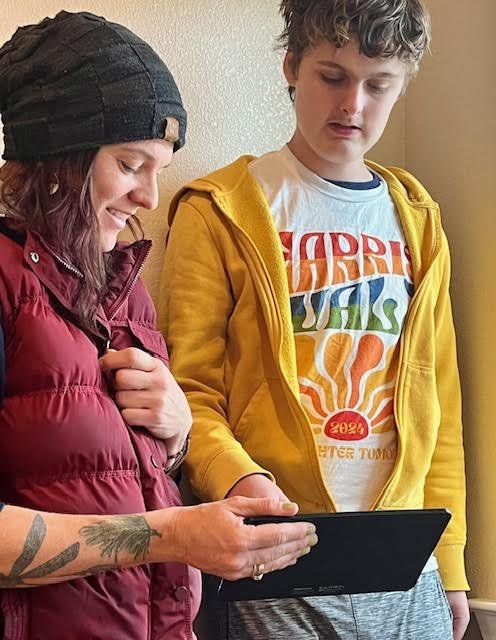
Saul, age 18
Resources
Getting Started with Functional AAC
Communication for Education, Online Communication Training for parents, families and educators: https://www.communicationforeducation.com
Communication 4 All, FREE Online Spelling education for families, parents, educators: https://communication4all.org
Autistically Inclined: Online courses and lessons: https://www.autisticallyinclined.com/
Adaptiverse: Online app for spelling lesson creation: https://adaptiverseapp.com
Books & Journalism about/by Spellers and their families
NoahRising: Poems, Noah McSweeny: https://www.amazon.com/NoahRising-Poems-Noah-McSweeney/dp/B0FGKC8NYH
Ido in Autismland: Climbing Out of Autism’s Silent Prison, Ido Kedar: https://www.amazon.com/Ido-Autismland-Climbing-Autisms-Silent/dp/0988324709
The Reason I Jump: The Inner Voice of a Thirteen-Year-Old Boy with Autism, Naoki Higashida: https://www.amazon.com/Reason-Jump-Inner-Thirteen-Year-Old-Autism/dp/081298515X
Underestimated: An Autism Miracle, J. B. Handley & Jamison Handley: https://www.amazon.com/Underestimated-Autism-Miracle-Childrens-Defense/dp/1510766367
Award-winning journalism by speller Noah McSweeny: https://www.theoakleafnews.com/staff_name/noah-mcsweeney/
Non-speaker Jakob Jordan uses new technology to star in the opera Sensorium Ex: https://www.npr.org/2025/05/24/nx-s1-5405023/opera-nonverbal-ai-sensorium-ex
Related Books about Autism
Autism in Polyvagal Terms: New Possibilities and Interventions, Sean M. Inderbitzen DSW LSCW: https://www.amazon.com/Autism-Polyvagal-Terms-Possibilities-Interventions/dp/1324053216
Documentaries & Videos by/about Spelling & Spellers
Spellers: The Movie: https://www.youtube.com/watch?v=8h1rcLyznK0
Daniel Bergmann: Breakthrough: https://www.youtube.com/watch?v=Ce7PWVaJ0xQ
Interview with Jordyn Zimmerman, non-speaking disability rights advocate: https://www.youtube.com/watch?v=mTECNar9yG4
Tools (Letterboards, etc.)
Growing Kids Therapy Center, Stencil Letterboards, Laminate Letterboards & Sensory Letterboards: https://growingkidstherapy.com/shop/
Reach Every Voice, Letterboards: https://www.reacheveryvoice.org/letterboards